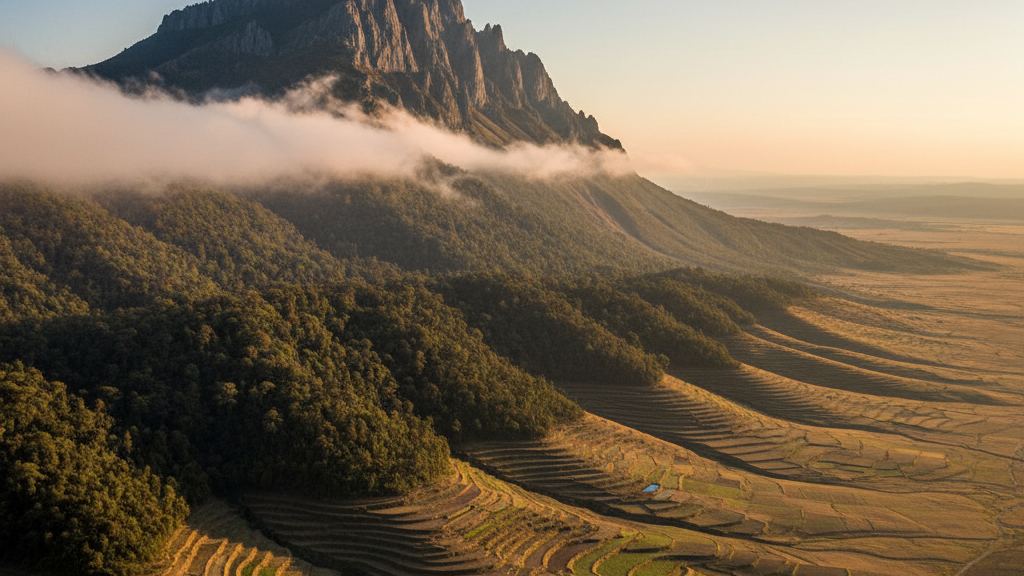
mist off the escarpment by nine, woodsmoke, plums in january
Reserve a week, three weeks or a season in the West Usambara mountains
The West Usambara mountains rise as one cold forested block out of a hot plain in northeastern Tanzania, and this office books a single place in them at three lengths: seven nights from $2,145 per person on two sharing, twenty one nights, or a fifty six night block. People go up for air at 1,400 meters, for an escarpment that stops and drops a thousand meters to the flats, and for forest that holds birds and chameleons found on no other mountain. The same room bought for a week and bought for a season is not one purchase in two sizes, and this page is about the difference.
Reserve your weeksA reply is written within one business day, by a person.
The West Usambara mountains stand as one block above the Mombo plain, and the road up is thirty two kilometers of tarmac with something like twenty two hairpins folded into it. You start on the flat at 400 meters, where the middle of the afternoon sits at 33 C, and an hour and ten minutes later you are at 1,400 meters in Lushoto looking through your bag for a jacket. A good number of the people who reserve a stay in the West Usambara mountains are buying that hour and ten minutes as much as anything else. Nothing in this corner of Tanzania takes the temperature down that far over that short a road.
This office books one place here at three lengths, and it treats them as three different things to buy rather than one thing in three sizes. Seven nights is a viewing. Twenty one nights is long enough for the mountain to run a full turn of weather and field work in front of you. Fifty six nights is long enough that the shop knows what you buy on a Tuesday.
The figures come out at about $307 a night on the week, about $233 a night across the twenty one nights, and about $191 a night across the season. The reason is mechanical rather than generous: a room let in one block for eight weeks is not stripped, scrubbed and made ready again every Saturday morning, and the household letting it does not price it as though it were.
A week
7 nights7 nights, from $2,145 per person.about $306 a night
Seven nights gets you one Thursday market in Lushoto, two walks in the Magamba forest above 1,700 meters, one morning at the escarpment edge at Irente, and one hot descent to the plain at Mombo, and then you are packing.
Three weeks
21 nights21 nights, from $4,893 per person.about $233 a night
By the third week you have been up the ridge road to Mtae and slept there, watched one terrace turned, planted and watered, learned which minibus leaves at six and which leaves when it fills, and stopped asking anybody what the weather is going to do.
A season
56 nights56 nights, from $10,717 per person.about $191 a night
After a month the shopkeeper writes your tea and bread on a slate and settles it on Fridays, the household stops billing laundry separately because it is washing anyway, and somebody asks you to a wedding, which is the week you stop being a person passing through.
- What this office books
- This office books the house or the pension room, the road transfer up from the plain and back down, and any guide you name in writing; it books no air ticket, no rail seat and nothing whatever that it owns, because it owns none of it.
- Who books it
- A person booking this wants to be cold at night in East Africa, to walk into forest from the door instead of being driven to it, and to stay in one small town long enough that it stops putting on a face.
- Why somebody picks elsewhere
- If you have three weeks in Tanzania and what you actually want is animals on open grassland, this is the wrong mountain and the money belongs in a park stay instead.
- In the figure
- the house or pension room for the whole run of nights, held in your name; road transfer up from the plain on arrival and back down at the end, once each way at any length; bed linen and towels, changed weekly on the seven nights and every second week on the two longer stays; drinking water delivered in twenty liter bottles, scaled to the nights; a cook three mornings a week on the twenty one nights and six mornings a week across the fifty six, and none on the week unless you ask; firewood and blankets from June through August, which is when you will want both; forest reserve entry for two walks on the week, four on the twenty one nights and open entry across the season; a named contact in Lushoto who answers a telephone in Swahili and English; and written directions in Swahili for every driver you are going to use.
- Not in the figure
- your air ticket, which stays yours to arrange, roughly $1,180 to $2,240 round trip from the Gulf Coast; the road run from the coast up to Mombo if you skip the transfer, $40 to $90; lunches and dinners eaten out, $4 to $12 a head in town; the cheese and bread run to the mission farm on the escarpment, about $9 a week; a guide for the Mtae ridge or the Shume forest, $25 to $45 a day for two; minibus fares down to Mombo and back, about $3 each way; a motorbike up the hill to Magamba, $2 to $4; a car and driver for a day out on the plain, $75 to $120; mobile data, $6 to $15 a month; and anything the operating company adds for a late arrival or a third bed, which it quotes and bills itself.
- Who should not book it
- Do not book this if you need English spoken to you outside Lushoto town, because the first language of these ridges is Sambaa and the second is Swahili. Do not book it if gradients are a problem: the villages are built down slopes, and the short walk to a shop can be a hundred meters of climb on a dirt path with no rail. The upper houses are cold and damp from March into May, the power goes off without notice for an hour or five, and hot water in several of them is a bucket carried in. And fifty six nights in a mountain town this size is mostly ordinary days, weeding and rain and the same six faces, which is precisely what some travelers came for and a shock to everyone else.
Each figure is a starting point for two people sharing one room. Costing the exact weeks you name takes two to four working days: the letting company must answer before a number exists, and an air ticket is never folded into one.
The climb from Mombo, and what is at the top
Lushoto is a market town of stone and render in a bowl, with ridges above it going to 1,800 meters at Magamba and past 2,000 further in. The forest up there is camphor and podocarp, thickened around the old forestry stations with pine and eucalyptus planted a hundred years ago, and it is loud at first light. Colobus move along the canopy in the Magamba reserve in troops of eight or ten. There is an eagle owl on this block that lives on no other, a two horned chameleon the length of your hand that crosses the track at dusk, and enough endemic plants that people with a professional interest come here and stay for months at a time.
The town itself carries a run of buildings from the hill station period: steep roofs pitched for rain that arrives sideways, verandas two meters deep, thick walls, put up by people who came inland from the coast to stop sweating. Several are still in use as offices and one is a school. The stock of houses that get let to visitors sits above and around them, mostly farm buildings with one wing given over, or two upper rooms in a family pension over the road to Soni.
The mountain works. Terraces of potatoes, cabbage, carrots and tomatoes climb the slopes and go down by truck to Tanga and Dar es Salaam, and the trucks come back up loaded with cement and rice. Coffee grows on the upper slopes and picking runs from late July. Plum and pear trees, grown from stock brought here a century ago, come in through the last two weeks of December. Market is daily in Lushoto and twice the size on Thursday, when the growers from Magamba and Kwai bring down whatever they lifted that week; Soni has its own on Tuesday, smaller and mostly for the valley. The bakery opens at six and is out by nine, and the bread van goes up past Magamba on Tuesday and Friday only, which is a thing you learn in week one and plan around by week three.
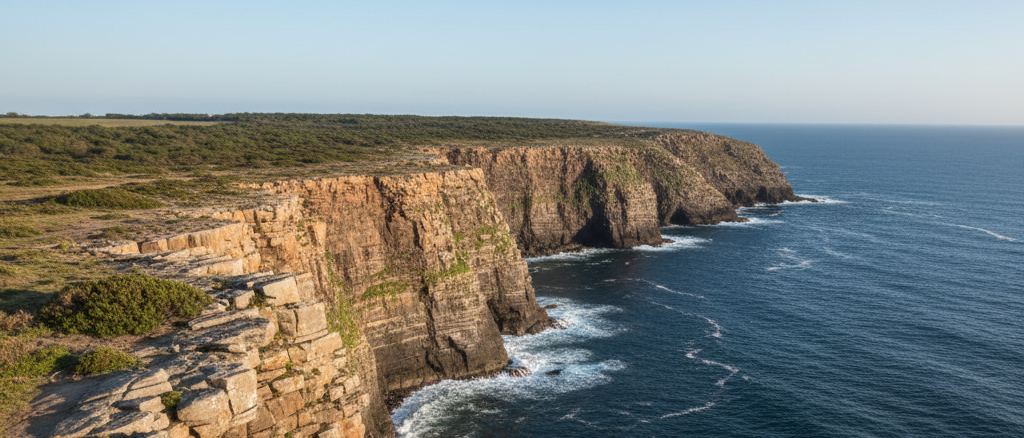
Seven nights, twenty one nights, fifty six
A week is a viewing and there is nothing wrong with that. You will get one Thursday market, two forest walks, one morning standing at Irente where the ground ends and drops a thousand meters to the Mazinde flats, and one hot day down at Mombo to remind you what you climbed out of. You will not see the weather change. Whatever the mountain is doing the week you arrive is the mountain you will describe afterward.
Three weeks is where it starts to be a different purchase. The second week is not a longer version of the first. By then you have made the ridge road to Mtae, which is sixty kilometers northwest of Lushoto on gravel and takes three hours, and slept a night up there at 1,600 meters looking down at the Mkomazi flats. You have watched one terrace turned, planted and watered. You know that the six o'clock minibus goes at six and the next one goes when it is full, which can be nine. If you are here in the second half of December you will have eaten plums off three different trees and been told, three times, that this year's are not what they used to be.
Fifty six nights is the length at which the arithmetic of a household changes rather than yours. Nobody turns a room over for you on a Saturday. Laundry stops being a line item because it is going in with everybody else's. The shop puts your tea and bread on a slate and settles on Friday. Somewhere in the fourth or fifth week you get asked to something, a wedding or a burial or a school day, and going to it is the whole reason to have booked eight weeks instead of three.
- January and February
- Plums finishing, then the driest weeks of the first half of the year; 22 C on the ridge by day, every gravel track open, dust on the Mtae road.
- March into May
- The long rains, arriving some time after the tenth of March; April is the wettest month at around 300 mm and the ridge fills with cloud by nine most mornings.
- Late May
- Rain thins out over ten days or so, the frogs are deafening at night, and the forest paths stay slick for a fortnight after the last of it.
- June
- Cold and clear, nights near 10 C at 1,400 meters, blankets doubled on the beds and woodsmoke through the villages from five in the afternoon.
- July and August
- The dry cold stretch; maize comes in, the Shume forest tracks are firm enough for a vehicle, and on a clear morning at Irente you can see the Pare range.
- September
- Coffee picking on the upper slopes, hot in the middle of the day and cold by eight at night, and the middle of the day is when nobody wants to talk to you.
- October
- The hot dry month before the short rains; the plain below touches 35 C and anyone with a choice stays up the hill.
- November into December
- Short rains, heavy for two or three hours in the afternoon and clear either side; potatoes go in and the plum trees fill.
The eight week block, from late June
Most of the season stays this office places run from the last week of June to the third week of August, and that is not an accident. The ground is dry, so the tracks to Shume and Sunga hold a vehicle. Nights sit near 10 C and the houses have firewood in them. The maize is coming in, which means everybody is outdoors and in a reasonable mood. And there is no rain to shut you inside a stone room with a book for four days running, which is what April does.
You can take the eight weeks in December and January instead, and two households will take that booking. It is warmer, the plums are on, and the short rains have stopped. It is also the busiest domestic travel period in the country and the road up from Mombo carries far more traffic on weekends.
Be honest with yourself about the shape of the thing. Fifty six nights here is perhaps six days that you would tell somebody about and fifty that consist of walking to the market, cooking, reading, a conversation on a wall, and going to bed at nine because it is dark by seven all year and there is almost no dusk. People who want that want it badly. People who do not should book the twenty one nights and go home while they still like the place.
Who books what, and who sends the bill
Slow Latitudes Bookings LLC is the company that stands behind Slow Latitudes, and it works from one office at 9422 Common Street, Suite 2, Baton Rouge, LA 70809. That address is in East Baton Rouge, Louisiana, and it is where every quote for these mountains gets written. Not one house, room, vehicle or guide described on this page belongs to the company. Each is run by a Tanzanian household or firm that holds its own permissions, meets you at the door, and writes your invoice in its own name. Money never comes through this office at all.
Tell us the dates and the length and it takes two to four working days to price them properly, because the houses are priced by the household and not off a rate sheet. No air ticket is sold here, so the journey out and back is yours to arrange, and we will tell you which arrival times the driver can actually meet. Entry paperwork is between you and the authority that issues it; this office does not advise on that and will not pretend to.
Call +1 (225) 766-2418 during working hours and ask for the person who handles East Africa, or write to bookings@slowlatitudes.com with your dates. If something has gone wrong on a booking already made, corrections@slowlatitudes.com gets to the same two people faster.
Ask this office to reserve your weeks
The form below is open every hour of every day, and what it collects is read by a person, who replies within one business day. Nobody is committed by sending it, nothing is charged for it, and no call or message goes out from here unless you ask for one.