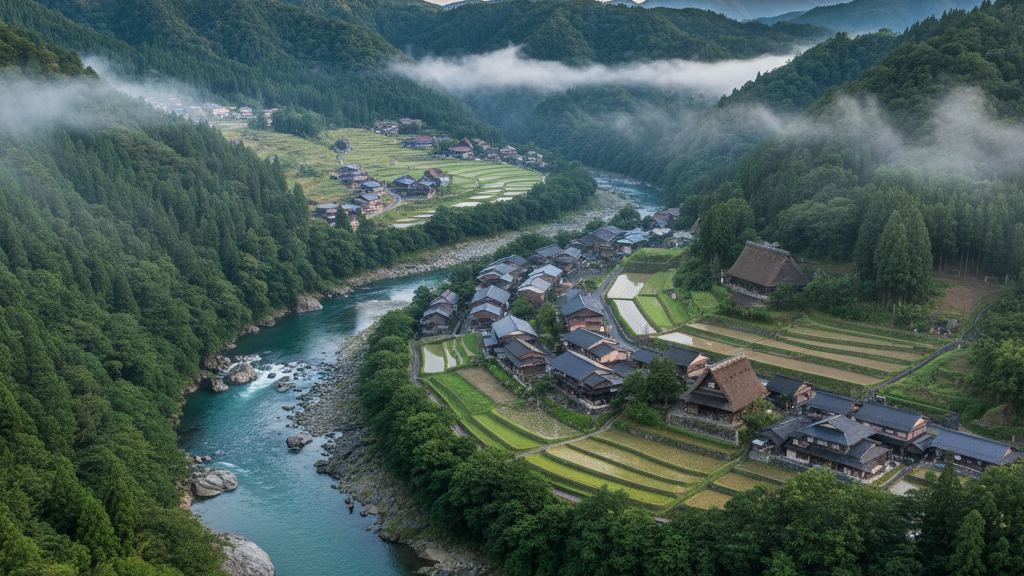
vine cable over a green river, woodsmoke, buckwheat cut in october
Reserve a stay in inland Shikoku for a week, three weeks or a season
The Iya and Shimanto valleys of inland Shikoku, at seven nights from $2,606 per person on two sharing, at twenty one nights, or at fifty six. The house is the same house at all three; what moves is how much of a working year you are standing inside it. People come for a gorge with a vine cable strung over it and a wide green river crossed by concrete slabs that carry no railings.
Reserve your weeksA reply is written within one business day, by a person.
You reserve a stay in inland Shikoku by naming a place and a number of nights, and on this page the number of nights is the entire decision. The place does not move: the Iya valley in the northern interior of the island, and the Shimanto river in the southwest, about ninety minutes apart by road. The house is the same house at seven nights, at twenty one and at fifty six. What differs is how much of one working year you are standing inside it, and that turns out to be a difference of kind rather than of amount.
The two valleys are shaped against each other. Iya is vertical. The river is a long way below the road, the road is a single lane with passing bays, and the settlement at the top is stacked on dry stone terraces with 390 meters of height between the lowest roof and the highest. The Shimanto is horizontal. It is broad and green and unhurried by the time it reaches the last thirty kilometers, and the low bridges that cross it were poured deliberately without railings, so that a flood passes over them and leaves them where they are.
Between the two runs the walking route that links eighty eight temples, and it has run through here for a very long time. Walkers come past the hamlet in March, April and May, and again through October, generally before seven in the morning, in white over ordinary clothes. The highest of the temples on the route sits at 911 meters. None of this is arranged for you and none of it stops when you leave.
A week
7 nights7 nights, from $2,606 per person.about $372 a night
A week gets you the vine bridge, the inclined car down to the bath on the river, the thatch and stone settlement on the ridge, one afternoon in a canoe on the Shimanto, and exactly one of the two mornings the cooperative van comes to the bus shelter.
Three weeks
21 nights21 nights, from $5,178 per person.about $247 a night
By the third week you have caught whichever harvest your dates landed on, buckwheat threshed on the road surface in the last ten days of October or persimmons peeled and strung under the eaves in November, and the woman running the van has started setting your tofu aside before you get there.
A season
56 nights56 nights, from $11,344 per person.about $203 a night
Past a month you are on the burnable rota with everybody else, you buy kerosene by the eighteen liter can, you know which afternoons the water goes off in the upper hamlet in August, and whole weeks pass in which you do nothing a visitor would write down.
- What this office books
- Slow Latitudes Bookings LLC places the house, the exact nights, the ground transfer from the nearest station and the introduction to the person who holds the key; it books no air travel, it owns none of the buildings, and it takes no money from you at any point.
- Who books it
- Somebody booking this wants a valley that goes on working whether or not there is anyone watching it.
- Why somebody picks elsewhere
- If you want a coast, kitchens that are still serving at nine, or a counter where somebody speaks English, take a different page, because this is farmed slope an hour above a supermarket.
- In the figure
- The house itself, two rooms and a hearth, held for the exact nights you name, which is the item that scales with the length; futons and linen, changed weekly on a week or three weeks and every tenth day on a season; electricity, water and the wood already split under the eaves, unmetered at every length; ground transfer from the nearest station on arrival and again on departure, once each way whatever you book; the first shop standing in the kitchen when you walk in, rice, miso, salt, tea, eggs and oil, one time only and the same at all three lengths; a two page sheet of local timings, bus departures, shop closing, van mornings and burnable days, redone in the month you travel; the introduction to the neighbor who holds the second key and has agreed to be telephoned; a bicycle for the valley road, one per person; the reservation placed with the company that runs the house and its paper read here before you sign it.
- Not in the figure
- Round trip air fare from the American South, which is your own arrangement, $1,150 to $1,880 per person; a small rental car, which you will want above the bus, $58 to $74 a day; fuel, about $4.40 to $5.10 a gallon at the pumps in the valley towns; expressway tolls from the north coast, $18 to $34 each way; eating, whether you cook or sit down, $22 to $60 a person a day; the vine bridge itself, about $4 a crossing, and the hot spring baths, $8 to $17 a visit; canoe hire on the Shimanto, $45 to $80 a half day; kerosene from December through March, $16 to $22 the eighteen liter can and three to five cans a month; winter tires or chains on the rental, $40 to $95 for the period; a prepaid data card, $22 to $40; the hamlet association contribution once you pass thirty nights, about $9 a month.
- Who should not book it
- Do not book this if you need people around you. The hamlet holds about sixty residents, most of them past seventy, almost nobody speaks English, and the ground goes up at a grade that makes an ordinary walk to a neighbor a climb of eighty meters. The houses are timber over an open floor and they are damp from June to August and cold in January whatever you do with the stove, and above 700 meters the snow closes the upper road for days at a time. A season here is mostly ordinary days, and if an ordinary day with nothing arranged in it makes you restless by Wednesday, seven nights is the honest length for you.
Each figure is a starting point for two people sharing one room. Costing the exact weeks you name takes two to four working days: the letting company must answer before a number exists, and an air ticket is never folded into one.
The seven nights, and the clock that beats them
A week is enough for the things people arrive wanting. You cross the vine bridge and look at the river through the gaps between your own feet. You take the inclined car down to the bath cut into the bank. You drive the ridge road to the thatch and stone houses and stand in a kitchen with a hearth in the floor and a fish skewered upright in the ash beside it. You put one afternoon on the Shimanto in a canoe and one evening watching a net go in for sweetfish, which the river opens for in June. It is a good week and it is a visitor's week, and there is no straight way to describe it as anything else.
What defeats a week is the local timetable. The single shop in the hamlet opens at eight, closes at six and shuts on Wednesday afternoons. The cooperative van parks at the bus shelter on Tuesday and Friday at about half past ten and is gone inside forty minutes. Three buses a day run down the valley while school is running, two on Sundays, and the last one back up leaves at 4:55 in the afternoon, after which the road belongs to whoever brought a car. Post office counters shut at four. In seven nights you get one Tuesday van and one Friday van, and if the Wednesday is the day you drove out to the coast, you come back to a dark shop and eat what is in the cupboard.
The third week, when the valley stops performing
The second week is where the road stops being scenery and you start seeing work. Buckwheat goes into the terraces in the middle of July and comes off in the last ten days of October, and for that fortnight the road surface itself is the threshing floor, tarps held down with stones and the whole family out on them. The flour is worked without wheat, which is why the noodles are cut short; a long one will not hold together. In the second week of November the persimmons come down off the trees and go straight back up, peeled and strung under the eaves twenty to a line, and they hang there into December while the color goes out of them. First tea is picked on the terraces in the opening week of May. Water goes into the paddies in the last week of the same month and the frogs start the night it does.
Twenty one nights buys you exactly one of those, whichever your dates land on, and it buys the second and the third Tuesday. That is the part that cannot be bought at seven nights at any price. By the third van you are not a stranger buying tofu, you are the household at the far end of the terrace that buys tofu, and one is already wrapped. The same happens with the walkers on the temple route. In the first week you look up when they pass. By the third you have seen the same two men four mornings running and you know one of them is faster on the climbs.
Three weeks is also the length at which the weather stops being an event. A typhoon week in late August or September can shut a road for a day or two, and inside a week that is the holiday; inside three weeks it is a Tuesday you spent indoors, and the road is open again on Thursday.
The year in this valley runs in the order below, and it is the same year whether you are standing in one week of it or in eight.
- january
- aonori raked out of the estuary shallows by hand in waders, snow lying above 700 meters, kerosene twice a month
- march
- the first walkers come through before seven, plum on the lower slopes, the shop restocks
- may
- first tea off the terraces in the opening week, water into the paddies at the end of it
- june
- the rain season, most of the year's 2,600 mm arrives between now and the middle of July, sweetfish season opens
- august
- water off in the upper hamlet about two hours most afternoons, the river warm enough to get into
- october
- buckwheat cut in the last ten days and threshed on the road, harvest night at the shrine mid month
- november
- persimmons peeled and strung under the eaves, yuzu picked in the southern valleys
- december
- sun over the east ridge at twenty to nine, off the valley floor by a quarter past three, nothing open on the first three days of January
Fifty six nights, and the ordinary days that make them
Eight weeks is not seven more weeks of the same week. It is a routine, and the routine is made of small municipal facts. Burnable waste goes out Tuesday and Friday, sorted nine ways, and there is no collection for about a week around New Year, so a season that runs through it means you keep your own rubbish in the shed for eight days like everyone else. Kerosene comes in eighteen liter cans from the stand in town and a cold January house takes four or five of them a month. Past thirty nights you will be asked for the hamlet association contribution, which is about nine dollars and covers the road verges and the shrine, and you should pay it. Somewhere around the fifth week somebody will ask you to help carry something, and that is the whole transaction.
The numbers behind the three lengths follow the same plain logic. Seven nights comes out at roughly $372 a night for each of two people sharing, twenty one at roughly $247, and fifty six at roughly $203. Nothing clever is happening. A room let for eight weeks is not stripped, cleaned and turned over every Saturday, nobody drives up to change the linen weekly, and the person letting it prices the work that is not being done. What the shorter stay buys is the freedom to want only the good fortnight of a season and take it.
There are things a season will not give you either. The valley does not open a second shop for you, and the bus does not add a run. February is the quietest part of the year here and the upper road can be closed for days after snow, and if that is the month you have, the honest description is that you will read a great deal.
How a booking is placed from Baton Rouge
Slow Latitudes is a booking office on 9422 Common Street, Suite 2 in Baton Rouge, East Baton Rouge Parish, Louisiana 70809. Tell us the valley and the nights and we go and price those exact weeks, which takes two to four working days at this end, because the house is one house and its owner answers when she answers. Nothing here belongs to us: no aircraft, no bedroom, no boat, no vehicle. The firm that runs the house holds the reservation under its own name and invoices you directly on paper it wrote, and we do not stand between you and that invoice or take a cent of it. Getting to Japan is your own arrangement and no figure on this page contains a flight. Entry paperwork is a matter between you and the authority that issues it, and this office does not advise on any of it.
Ask by telephone on +1 (225) 766-2418, or write to bookings@slowlatitudes.com. If something on this page has gone out of date, and timetables here do, tell us at corrections@slowlatitudes.com and we will go and check it.
Ask this office to reserve your weeks
The form below is open every hour of every day, and what it collects is read by a person, who replies within one business day. Nobody is committed by sending it, nothing is charged for it, and no call or message goes out from here unless you ask for one.