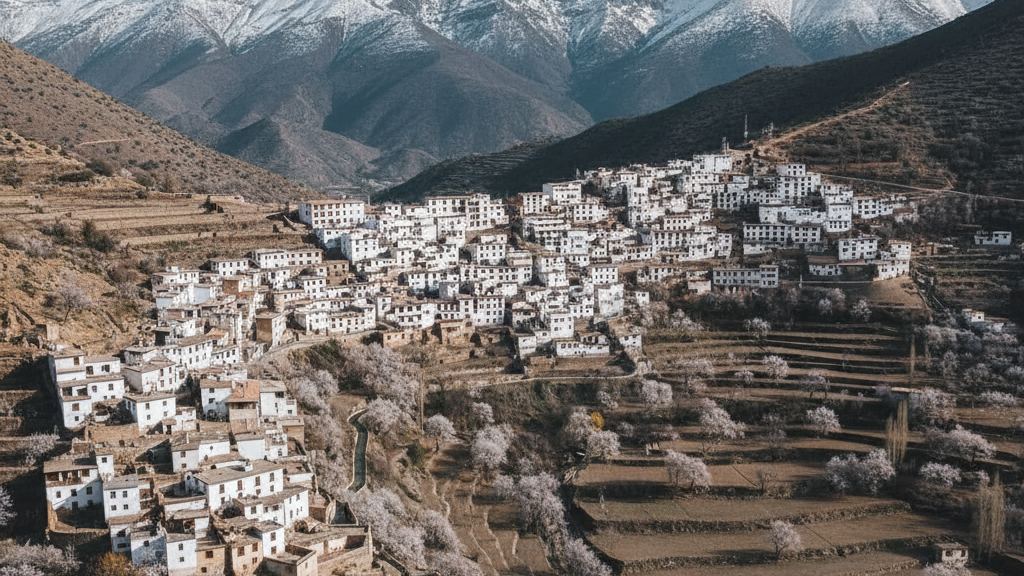
grey clay roofs, snowmelt on a rota, chestnut smoke from late october
Reserve a stay in Las Alpujarras for a week, three weeks or a season
One place on the south face of the Sierra Nevada, offered at three lengths, from $2,347 per person for seven nights with two sharing. The villages stand between 450 and 1,476 meters on terraces watered by channels older than the road. What a week shows you there is not a shorter version of what a season shows you.
Reserve your weeksA reply is written within one business day, by a person.
You can reserve a stay in Las Alpujarras at three lengths, and they are not one product in three sizes. The place is a run of villages along the south face of the Sierra Nevada in Granada province, sitting between about 450 meters at the valley mouth and 1,476 meters at Trevélez. The houses are flat roofed and packed against each other, one family's roof serving as another's terrace, and the roofs are sealed with a grey mica clay called launa that has to be rolled flat again after heavy rain. Streets duck under the upper floors of houses in covered stretches called tinaos. Mulhacén stands at 3,479 meters over the whole arrangement and keeps snow in its north gullies into July.
Water explains why the villages sit where they do. Channels cut along the contour, some of them a thousand years old, carry snowmelt around the hillside and let it down onto terraces of almond, olive, fig, chestnut and vine. A second set of channels higher up spreads water over bare ground so that it sinks in and comes back out of springs six or eight weeks later, which is why a village at 1,300 meters still has water in August while the river below it is down to a thread. Every village has a turn. If your house has a garden, somebody will tell you within a day which afternoon the water is yours and how long you get it.
What separates the three lengths is how far into that arrangement you get. Seven nights gives you the shape of the place. Twenty one nights gives you the same ground three times over in weather that has moved. Fifty six nights puts you inside one full turn of the farming year, and somewhere around the fourth week people stop asking how long you are staying.
A week
7 nights7 nights, from $2,347 per person.about $335 a night
One Thursday market, the three Poqueira villages, two or three of the channel paths, and the roofs and terraces fixed in your head.
Three weeks
21 nights21 nights, from $5,285 per person.about $252 a night
Three market Thursdays and enough repetition that you walk the channel path to the next village in two hours forty instead of four, over ground you have now seen in two different weathers.
A season
56 nights56 nights, from $10,864 per person.about $194 a night
You land inside a harvest rather than beside one, the shop starts holding things back for you, and laundry stops appearing on the bill because nobody is turning the room over on Saturdays.
- What this office books
- The office books the house or the room and the road transfer at each end, and it books no flight, no sea passage, no meal and no guide.
- Who books it
- Somebody booking this wants a working farming year going on around them without being asked to join in.
- Why somebody picks elsewhere
- If you want a coast, museums, restaurants open on a Monday in February, or a shopkeeper who will meet you in English, a town on the Granada plain would suit you and this will not.
- In the figure
- Every night named, in a stone village house or a room above a family pension, held under the operating company's own contract, and it is the same house for the whole stay at any length; one road transfer in each direction between the arrival airport and the village, identical whether you take seven nights or fifty six; linen and towels, changed weekly on the seven and twenty one night stays and every second week from the fifth week on; electricity, water and the winter fuel allowance, all of which scale with the length; use of the terrace or garden where the house has one, and the village water turn that comes with it; a walk around the village on the first full morning covering shop hours, the bus stop, the water rota and the two footpaths out; a run down to the Thursday market in Órgiva, once on a seven night stay and every week on the longer two; a month by month sheet for the exact weeks you are there, listing harvest dates, fiesta dates and what closes; a phone number for the operating company's representative in the valley, answered in Spanish and English; and that company's confirmation in writing before anything is held.
- Not in the figure
- Your flight, which never appears on a figure from this office and runs about $780 to $1,640 round trip from the American South depending on the month; checked bags, $70 to $180 round trip; car hire in the valley, $265 to $430 a week and higher in August; fuel and the coast road tolls if you drive, $45 to $95 a week; all food and drink, with a village midday menu at $14 to $19 a head and a week of shopping for two at $95 to $145; firewood beyond the allowance from December to February, $120 to $195 a load of almond and olive; a walking guide for the high ground, $185 to $310 a day for two; the park minibus above Capileira in the months it runs, $18 to $26 per person round trip; laundry beyond what the house does, $9 to $16 a load; and anything you ask the operating company to buy and keep for you, at what it cost.
- Who should not book it
- Do not book this if you need a car to reach your own door, because in the upper villages there is no such door. Do not book it if your knees object to sixty steps carried twice a day, if damp stone and a 54 F kitchen in January will make you miserable, or if you need to be answered in English at the shop. A season here is mostly ordinary days: the same two shops, the same walk, three places to eat of which one is shut, and long stretches in November and February when it rains for four days and there is nothing at all to do. If that reads as a shortage rather than the point, take a week and see.
Each figure is a starting point for two people sharing one room. Costing the exact weeks you name takes two to four working days: the letting company must answer before a number exists, and an air ticket is never folded into one.
The Thursday market, the bread van, and the bus that stops everywhere
Órgiva is the market town at the bottom of the valley, 450 meters up and about fifty minutes from the sea at Motril. The market runs on Thursday morning, roughly eight until two, and it is the one day of the week when the upper villages come down together. Fruit, cheese, work clothes, plastic buckets, seed potatoes in March: about forty stalls in winter against seventy in July. On a seven night stay you catch it once, and you will spend part of that hour working out what the shouting is about.
Higher up, supply is thinner and it runs to a timetable. In the small hamlets of the Taha the van that brings bread and a little else comes twice a week and sounds its horn once at the top of the street, and if you are out on a path you go without until it comes again. The butcher in the larger villages shuts Monday, as does at least one of the two or three places to eat, and in February one of those usually closes for the whole month. The bus up from the provincial capital covers 70 kilometers in a little over three hours because it calls at every village on the way. There are three of them on a weekday and two on Sunday. The school buses down to the valley floor do not run in July or August, which catches people out.
Trevélez has the ham sheds, at 1,476 meters, and they are there for the air rather than the view: cold, dry and moving, for fourteen to twenty months a leg. Pórtugos has an iron spring that has stained its own stone basin orange. Neither of those is a sight you look at for more than four minutes, which is the honest measure of this valley.
What the fourth week reaches that the first cannot
Almonds come off from the last week of August through September, knocked out of the trees with cane poles onto sheets spread across the terrace. Figs are picked in the second and third week of September and laid on cane frames to dry, and the grapes on the Contraviesa ridge to the south go in from about the fifteenth. That fortnight is the busiest of the year and also the least sociable: people start at six and will say hello and keep walking. Chestnuts follow in the woods above Pórtugos and Pitres from late October and run for about three weeks, and the first fires go in around the same time.
Seven nights lands in one of those weeks or in none of them. Twenty one nights will usually straddle two. Fifty six nights takes you over the join, so you see the same terraces before, during and after, which is a different picture of the same ground rather than more of it.
The other change is domestic and it happens without announcement. By the third week you know the shop keeps a second, better bread behind the counter for people who ask. By the fifth or sixth, most landladies stop itemizing laundry, because nobody is stripping the bed every Saturday. The track that climbs north out of Capileira is barred to private cars at about 2,150 meters, and the park minibus above that point does not begin until the snow is off it, which in most years is the last week of June. Arrive in the middle of May for eight weeks and you are there on the day it starts.
Your legs change as well. A walk along the channel path to the next village that takes four hours in your first week takes two hours forty in your third, because you have stopped breathing like somebody who lives at sea level.
- January
- Snow down to about 1,200 meters two or three times. Around 48 F by day in Capileira, near 30 F at night. Olives still coming off the low terraces.
- February
- Almond blossom from about the tenth at 1,000 meters, ten days later higher. One of the two places to eat in most villages shuts for the month.
- April
- The channels are at their loudest, running full off the thaw, and the terraces are cut for the first hay.
- June
- Light until half past nine. The high track out of Capileira usually clears in the last week and the park minibus starts.
- August
- 100 F at the valley mouth, 84 F at 1,400 meters, nights near 58 F. Walkers go up the mountain overnight on the fifth. Bérchules keeps New Year on the first Saturday.
- September
- Figs off in the second and third week and onto the drying frames. Grapes on the southern ridge from about the fifteenth. Everybody is busy and nobody wants to talk to you.
- November
- Chestnuts above Pórtugos and Pitres for roughly three weeks. First fires lit. The ham sheds open their shutters to the cold.
- December
- Sun off the street in the gorge by a quarter past four, nine and a half hours of light, and an unheated house sitting at 54 F all day.
Gradient, stone, and the parts of this that are simply hard
Nothing reaches a house in the upper villages by car. You park where the street narrows and carry the rest, and in Capileira that can be sixty or seventy steps with a bag in each hand, twice, because you always forget something. The walls are two feet of stone and they hold whatever temperature you left them at. In August the valley mouth runs to 100 F in the afternoon while 1,400 meters up it is 84 F and the night drops to about 58 F, which is the entire reason people have been coming up here in August for two hundred years. In late December there are nine and a half hours of light, the sun is off the street in the Poqueira gorge by about a quarter past four, and a house nobody has heated sits at 54 F in the middle of the day.
Outside the four or five villages that see walkers, the working language is Spanish and there is no second one. Nobody will be rude about it and nobody will switch.
Entry rules for Spain are a matter between you and the authority that issues your documents, at any length of stay, and this office does not advise on them.
How a stay here is priced and who sends the bill
Slow Latitudes is the name Slow Latitudes Bookings LLC works under at 9422 Common Street, Suite 2, Baton Rouge, LA 70809, in East Baton Rouge, Louisiana. Nothing that carries or houses a traveller is owned at that address. The house or the room is held by the company that runs it on the ground, under a contract of its own, and that company sends you the bill and takes the money. This agency places the reservation, checks it against what you asked for, and stays on the file until you are home.
You buy your own flight. Nothing with wings appears on a figure from here, and the transfer named in the price is a road transfer made by a licensed local operator under its own permits.
The three figures on this page hold at seven, twenty one and fifty six nights with two people sharing. That works out at $335 a night for the week, $252 a night for the three weeks and $194 a night for the season, and the reason the nightly figure is not the same at each length is that a room let for eight weeks is not turned over, cleaned and re-let every Saturday. Nobody is doing that work, so it is not in the number.
Costing the exact weeks you pick takes two to four working days, because the operating company answers first and it answers about specific dates rather than about a month in general. Send the weeks you have in mind and how many of you there are to bookings@slowlatitudes.com, or call +1 (225) 766-2418 during the working day in Baton Rouge. If something needs correcting after a stay is confirmed, that goes to corrections@slowlatitudes.com.
Ask this office to reserve your weeks
The form below is open every hour of every day, and what it collects is read by a person, who replies within one business day. Nobody is committed by sending it, nothing is charged for it, and no call or message goes out from here unless you ask for one.