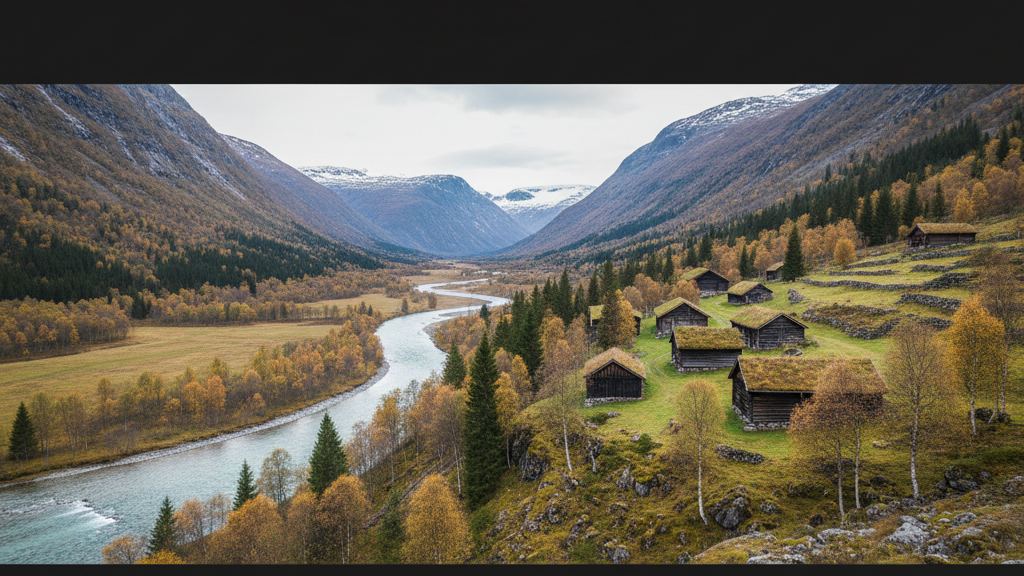
log walls, a dry valley, hay cut twice, snow by november
Reserve a Farm Stay in Gudbrandsdalen for a Week, Three Weeks or a Season
Gudbrandsdalen is a long inland valley of timber farms running northwest out of Lillehammer, and Slow Latitudes holds a room or a wing on one of them for seven nights from $2,569 for each of two people sharing, for twenty one nights, or for a season of fifty six. People go for the dry air on the terraces, for the two hay cuts and the berry weeks, and for a house with a foot of log wall between them and January. The length you choose decides how much of the farming year you are actually present for.
Reserve your weeksA reply is written within one business day, by a person.
Reserve a farm stay in Gudbrandsdalen and the thing being held for you is a room, or a whole wing, in a log building on a farm that still runs stock. The valley goes northwest for about 140 miles, from the head of the long lake at Lillehammer to where the ground opens out onto the plateau at Dombas, and every old farm in it stands on the one bank that keeps the afternoon sun. The buildings are timber, silver on the weather face and oxblood on the rest, set around a bare courtyard with a store loft standing up on stone legs at one corner so the mice cannot climb into the flour.
This office lets the same farm at three lengths and treats them as three separate things rather than one thing multiplied. Seven nights shows you a valley. Twenty one nights lets the fields change while you are standing in front of them. Fifty six nights carries you across most of one working year up here and past the week when anybody still asks how long you are staying.
Each figure below is for one of two people sharing, and no air ticket sits inside any of them. Divided out by night, seven nights comes to $367 each, twenty one nights to $283, and fifty six nights to $212. What sits behind the three numbers is turnover and nothing else. A room held by the same two people for eight weeks is stripped, aired and made up once instead of eight times, the transfer from the station happens twice instead of sixteen, the farmer's wife spends her Saturday on her own work, and the farm charges for the labor it actually performs.
A week
7 nights7 nights, from $2,569 per person.about $367 a night
One weather, one Saturday, one clear day on the ridge behind the farm, and the shape of a valley with none of its calendar attached to it.
Three weeks
21 nights21 nights, from $5,943 per person.about $283 a night
The first hay cut goes on the low fields inside three or four dry days, so if your weeks straddle it you watch the field below the house change color twice, and by the end of the second week you have stopped checking the bus times because you know them.
A season
56 nights56 nights, from $11,872 per person.about $212 a night
Around the fourth week the wash stops being counted, you are handed the key to the forest road gate instead of the code, the mountain road west opens under you, and somebody asks in September whether you are walking out to bring the sheep down.
Whatever length you name, the sequence is the same. You send this office your weeks and the number of beds, we write to the farms letting rooms in that stretch of the valley, and an answer worth having takes two to four working days, because it turns on whether the hay is off and whether the side road is clear to the top farms. Nothing on this page belongs to us: not the house, not the woodshed, not the track up. The farm that puts the key in your hand is the one that writes your invoice, in kroner, on its own paper, and no money moves through this office in either direction.
- What this office books
- This office holds the nights on the farm and the road transfer between the valley station and the farm gate, and it sells no air ticket, no rail seat, no rental car and no place on anybody's excursion.
- Who books it
- Somebody reserving this wants a valley that still works for a living rather than for visitors, a house they heat themselves, and enough weeks that the place stops performing.
- Why somebody picks elsewhere
- A person who wants a coastline, a kitchen serving after nine at night or a day arranged for them by somebody else should reserve a different place, because this valley supplies none of the three and will not pretend to.
- In the figure
- The room or the wing on a working timber farm for the nights named, two people sharing, on all three lengths; bed linen and towels, changed weekly on the seven and twenty one night stays and every second week across a season; birch for the stove, one crate a week on the shorter stays and the run of the woodshed once the stay passes a month; electricity, water from the farm's own spring and bottled gas at the level two people use, with no meter reading at the end; the road transfer between the valley station and the farm gate, once each way whatever the length; use of the summer kitchen, the drying loft and the outside line; the household wash taken in rather than counted by the load, on the fifty six night stay only; a hand drawn sheet of the farm tracks showing which gates are locked and which are not; the farm's own eggs and potatoes when there are any, which is most of the year; together with the letting company's own written note of what it will invoice and on what date.
- Not in the figure
- Your flight, which is your own arrangement start to finish, $860 to $1,590 round trip per person out of the American South; the rail leg up the valley, $55 to $95 each way per person; a rental car, which most people take for at least part of a longer stay, $61 to $98 a day plus fuel at roughly $7.40 a gallon; groceries, $110 to $165 a week for two people cooking; a meal in the one place in the village that serves them, $34 to $52 a head; forest road tolls, $6 to $9 a gate, paid into a box at the barrier; skis, boots and poles hired for a winter month, $210 to $320 per person; guided gathering days and the horse work some farms sell on their own account, $70 to $140 a day; and anything you break, at the farm's own cost.
- Who should not book it
- The nearest town with more than one shop is 25 to 40 minutes down the valley, the bus that goes there runs on school days and not at all in July, and if quiet unsettles you the second week will be worse than the first. Farm tracks climb 600 feet in under a mile, they ice from the middle of October, and there is no version of this stay that does not involve walking up. English is understood almost everywhere and spoken well by anyone under fifty, but the neighbor whose field you cross speaks a valley dialect that Norwegians from the coast also have to slow down for. Eight weeks in a parish of 900 people is mostly ordinary days, and if you need something arranged for you every second afternoon you will be counting them by the third week.
Each figure is a starting point for two people sharing one room. Costing the exact weeks you name takes two to four working days: the letting company must answer before a number exists, and an air ticket is never folded into one.
The sun side, the shade side and the ridge above both
The floor of the valley climbs from 600 feet at the lake to about 2,150 feet at the top end, and the farms sit above it in terraces, mostly between 1,000 and 1,800 feet, on the bank where the sun stays longest. That is not a matter of view. Around the solstice the sun is up from about half past nine until a little after three, and on ground under the west ridge it does not clear the skyline for five or six weeks together, which is why nobody ever built a farm there and why the shade side is forest to this day. The whole valley lies in a rain shadow. Fifteen to seventeen inches of rain fall in a year, three or four times that comes down on the coast four hours west, and log walls survive here because they dry between showers instead of staying wet from October to May.
Distance is the other governing fact. The village most of these farms belong to has one shop, a fuel pump and a school. The shop opens at nine and closes at seven on weekdays and at four on Saturday, and on Sunday nothing opens except the pump. The town with two shops, a pharmacy and the state liquor store is 25 to 40 minutes down the valley, and the state shop closes at three on Saturday, which catches people out once each. A bakery van comes up the side road on Tuesdays and Fridays and has usually turned around by half past ten. The bus down to the valley floor runs on school days, twice in the morning and once at twenty past three, and does not run in July at all. Trains leave the valley station south six or seven times a day and take two and a half to three hours.
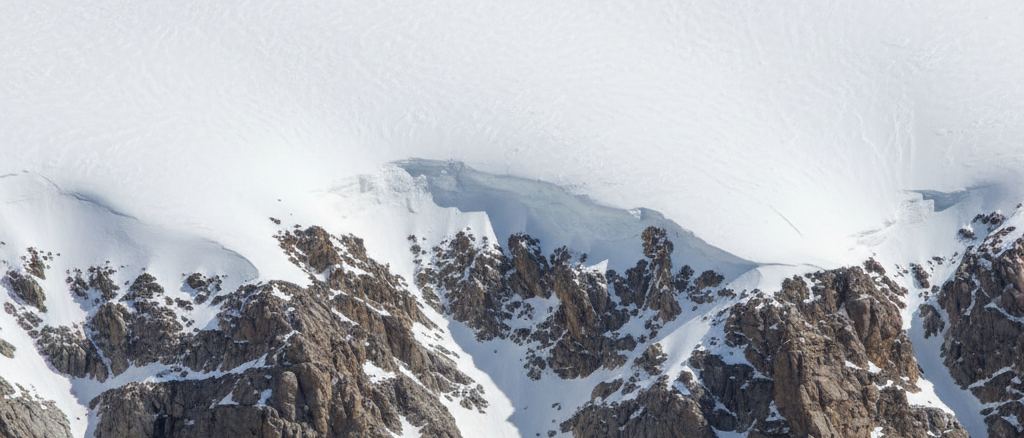
What a week, three weeks and a season each reach
A week is one weather and one Saturday. You get up the ridge behind the farm once if the cloud lifts off it, you walk the river path, you drive down to the stave church twenty minutes away, black with pine tar, roughly eight hundred years standing and open to visitors from the last days of May to the second week of September, and you go home with the shape of the place and none of its calendar.
Three weeks takes you past the point where the farm is scenery. Hay is the plainest example. The first cut goes on the low fields in the last week of June and needs three or four dry days in a row, and the high farms follow two to three weeks behind, so a stay that straddles it means the field under your window is long, then cut, then baled, then green again in the time you are there. By the end of the second week you know which of the two shops keeps oat flour, you have been up the same track in three different weathers, and the man who lifted a hand from the tractor on day four asks where you got to on Tuesday.
Fifty six nights changes the arrangement rather than the itinerary, and the changes are domestic. Somewhere in the fourth week your wash goes in with the farm's own and stops being written down. You are given the key to the forest road gate instead of the code, because the code gets changed and nobody wants to telephone you about it. In the fifth or sixth week the plows finish the mountain road west and a whole side of the map that was shut becomes an afternoon and a packed lunch. In the second and third weeks of September the sheep come down off the summer pastures, which takes two days and about fourteen people spread across a hillside, and the invitation to walk out with them is not extended to anybody who is leaving on Saturday.
- late April
- The river runs high and brown off the snowmelt, the last drifts go off the home fields, and nothing is green yet.
- May
- Lambs out, birch in leaf by the middle of the month on the low ground, the mountain roads west still under snow at the top.
- June
- Light enough at midnight to see the far ridge, first hay cut in the last week on the valley floor, mosquitoes on the bogs after rain.
- July
- The warmest and the busiest, 66F to 72F in the afternoon, the bus not running, and half the valley away at its own summer place.
- August
- Second cut about the middle of the month, cloudberries off the high bogs, and the spring can go thin for two hours most afternoons in a dry year.
- September
- Sheep down from the summer pastures in the second and third weeks, potatoes lifted, and the farms unavailable for ten days from the 25th for the hunt.
- October
- Frost every night from the middle, tracks icing, the high road west shut with the first serious fall.
- November to April
- Snow on the valley floor, sun off the shade side farms for five or six weeks around the solstice, groomed tracks from the first week of January.
How the farm holds your weeks, and who sends the bill
Tell this office the weeks, the number of people, whether you want a wing to yourselves or a room in the farmhouse with a family in the rest of it, and whether you need a car standing at the gate when you arrive. We put the request to the farms, they come back with a figure and a written statement of what they will charge and on which date, and you decide from that. No air ticket is sold here, so the flight into Norway is yours to put together, and so is the rail leg up the valley. Whatever paperwork your dates call for is settled between you and the body that issues it, we give no guidance on that, and the answer is the same whichever of the three lengths you take.
Slow Latitudes Bookings LLC does business as Slow Latitudes and works out of 9422 Common Street, Suite 2 in Baton Rouge, LA 70809, in East Baton Rouge, Louisiana. Call +1 (225) 766-2418 with your weeks in front of you, or write to bookings@slowlatitudes.com and put the dates in the first line. If something on this page has gone wrong, corrections@slowlatitudes.com reaches the person who keeps it.
Ask this office to reserve your weeks
The form below is open every hour of every day, and what it collects is read by a person, who replies within one business day. Nobody is committed by sending it, nothing is charged for it, and no call or message goes out from here unless you ask for one.