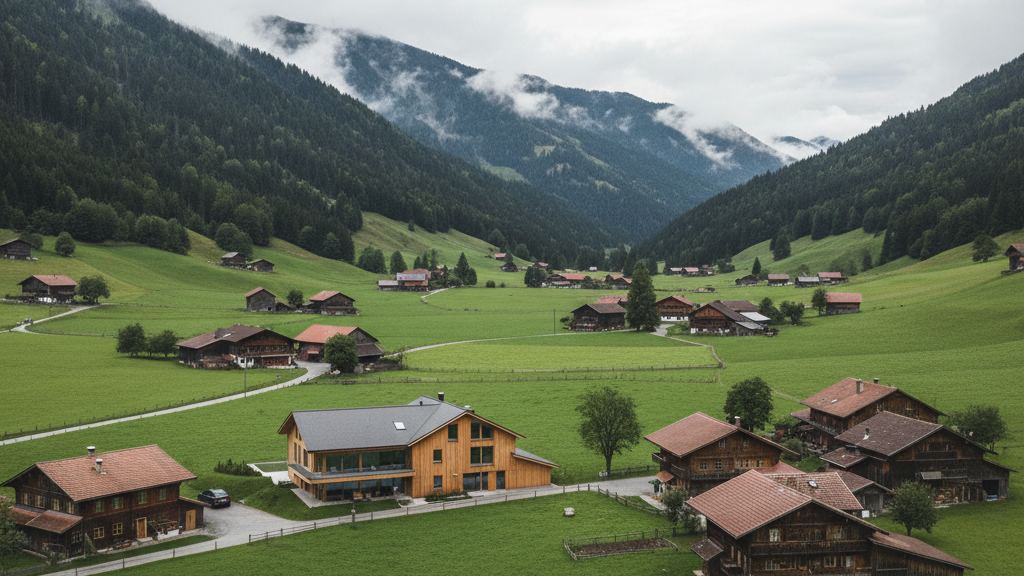
milking at five, rain on split shingles, hay cut twice
Reserve a stay in the Bregenzerwald for a week, three weeks or a season
The Bregenzerwald is a run of dairy valleys in western Austria, and Slow Latitudes reserves it at three lengths: seven nights from $2,495 per person on two sharing, twenty one nights, or fifty six. Cattle here are walked up the mountain in stages and walked back down in stages, so how much of that year you stand inside is decided by how long you take the house for.
Reserve your weeksA reply is written within one business day, by a person.
The Bregenzerwald is a run of dairy valleys in Vorarlberg, the westernmost state of Austria, climbing southeast off the Rhine plain toward the passes. Roughly two dozen villages, something over 30,000 people, a floor that begins near 560 metres and reaches 860 by the head of the valley, and one settlement out on a shelf at 1,428. Two things sit on top of one another here and between them they are the whole of the place: farms that still walk their cattle up and down the mountain in three separate moves a year, and forty years of new timber building put up by joiners from those same villages.
Because the farming is a timetable and not scenery, the length you take the house for decides what you actually stand in front of. The herds leave the home farms for the mid pastures in May, go higher again to the alps in the second half of June, and come back down between the middle of September and the first days of October. Seven nights sets you down inside one of those phases. Twenty one carries you over a boundary from one phase into the next. Fifty six holds an entire stage end to end, and somewhere in the fifth week you stop watching the timetable and start arranging your own day around it.
Slow Latitudes reserves the stay at all three lengths, in a farm apartment, a let wing of a house that is still worked, or a family pension above a village square. The house is picked for the length, because a room turned over and re-made every Saturday is not the same room as one let for eight weeks, and the nightly figure is set for each length on its own: about $356 a night across the week, $285 across three weeks, $219 across the season. Costing the exact weeks you pick takes two to four working days, because the question goes to the operator on the ground first, and in June and September it comes back late.
A week
7 nights7 nights, from $2,495 per person.about $356 a night
Seven nights puts you inside one weather and one phase of the farming year, which is enough for two or three village dairies inside their two hour morning counter, one climb to a mid pasture at about 1,200 metres, and one run down the valley on the bus.
Three weeks
21 nights21 nights, from $5,985 per person.about $285 a night
By the third week the herd has moved to ground it was not on when you arrived, the first hay is in and the regrowth is at your knee, and you know without asking which two mornings the shop van climbs to the upper hamlets and which afternoon the dairy has nothing left to sell.
A season
56 nights56 nights, from $12,264 per person.about $219 a night
After a month a farm keeps a can back for you at the five o'clock milking, the room stops being stripped and re-made every Saturday, and you are still in the village in the third week of September when the cattle come down the road with bells on and the whole street stands out to count them.
- What this office books
- Slow Latitudes reserves the house or the farm apartment, the ground transfer from the valley railhead, and the working visits that have to be asked for days ahead; it reserves nothing that flies and nothing that sails, and it takes no payment of any kind.
- Who books it
- People who reserve this want to watch one small agricultural year happen at arm's length, in a valley where the new buildings were drawn and cut by the families who keep the cows.
- Why somebody picks elsewhere
- If you want sun on a terrace most afternoons, take somewhere south instead, because this valley catches the wet coming off the big lake to the northwest and takes something close to 1,800 millimetres of rain and snow a year, a good part of it as thunder after two o'clock in July.
- In the figure
- The house, farm apartment or pension room for every night reserved, two sharing, with heating and firewood; bed linen and towels, changed weekly on the seven and twenty one night stays and on request after that; the end of stay clean, once, whatever the length; the ground transfer between the valley railhead and the house on arrival and departure, one pair of runs whatever the length; the regional card that carries you on the valley buses and up the summer lifts, issued for every night, so it scales with the stay; the municipal guest tax for every night, so it scales too; a standing introduction at a village dairy so you can buy at the morning counter without explaining yourself each time; two walks with a local walker on the seven night stay, four on the twenty one, and one a week after that; one working visit that has to be asked for in advance, a mountain dairy in summer or a joinery in winter, one on the week and one a fortnight thereafter; a written sheet of bus times and the walk in and out of the closed valley settlement, updated the week you arrive.
- Not in the figure
- The flight, which is yours to buy and never ours to sell, roughly $820 to $1,640 round trip from the Gulf Coast outside July and August; rail and road from the arrival airport to the valley railhead, $45 to $110 each way per person; a car if you want one, about $390 to $620 a week and more from December to March when winter tires are on it; food, which runs about $95 to $150 a week per person cooking at home and $22 to $38 for a plate at a village inn; winter lift tickets, $58 to $71 a day, outside the months the regional card covers; laundry beyond what the house does, $6 to $9 a load at a village machine, and nothing at all on the season once the arrangement settles; the narrow gauge line, the baths and the small museums, $8 to $26 each; nights in a mountain hut if you walk over a ridge and stay there, $52 to $78 with an evening meal; luggage carried up to a mid pasture by farm vehicle, $30 to $55 a load.
- Who should not book it
- This is a working agricultural valley with steep ground and almost no flat walking, because the path out of most villages goes up at once and keeps going, and if stairs are a problem the houses will be too, since a farmhouse let puts the bedrooms under the roof. In November and again in late April the lifts stop, the mid pastures are shut and empty, and several villages go down to one shop with morning hours, so there are weeks with nothing organised in them at all. The dialect is hard for German speakers and harder for everyone else, and a farmer of seventy may have no English whatever. Fifty six nights in a village of 900 people is mostly ordinary days, rain on the window and a walk you have already done twice, and anybody who needs a new thing every morning should take the week and mean it.
Each figure is a starting point for two people sharing one room. Costing the exact weeks you name takes two to four working days: the letting company must answer before a number exists, and an air ticket is never folded into one.
Where the cattle are the week you arrive
Three stage farming is why this valley looks as it does, and why a date is worth arguing over. The home farm holds the herd from November to May. Around the middle of that month the cattle walk, on the road, to the mid pastures between roughly 1,000 and 1,400 metres, where a family keeps a second small house and works six weeks or so. In the second half of June they go up again to the alps and stay until the grass is finished. Every meadow they are not standing in is shut for hay from mid May, which is why the footpaths are narrow, marked and meant, and why cutting a corner across grass in June will be remembered about you.
Seven nights in the first ten days of June finds the mid pastures occupied and the alps still shut. Seven nights at the end of that month finds the reverse, the valley meadows mown flat and the barns filling. Those are two different holidays in the same house at the same price. Twenty one nights across that fortnight gets you both ends of it and the move itself, which happens on an ordinary working morning without notice and takes about four hours gate to gate. Fifty six nights from the start of June holds the ascent, the first cut, the whole cheese making season on the mountain, the second cut in early September, and the descent.
That descent runs village by village from the middle of September into early October. The head cow is dressed with a worked headpiece and a bell if nobody died on the mountain that summer, and comes down plain if someone did. The date is not fixed more than a few days ahead, because it turns on the grass and the forecast, and nobody will commit to it in March. A season reservation is the only length that can put you in the street for it rather than near it.
The joiners, and what they have built here
Since the early 1980s the carpenters of these villages have been handed the public work as well as the barns, and the result is a valley where a bus shelter is worth ten minutes of your morning. One village of about a thousand people put up seven of them in 2014, each drawn by an architect from a different country, and they stand at ordinary stops on the ordinary route with the paper timetable taped inside. A fire station, a school, a milking parlour and a farmhouse extension will have come from the same three or four workshops, cut to the same standard of joint. On the weather side of the older houses the shingles are split by hand, laid to overlap by two thirds, and go silver in about six years.
A workshop will usually let two people put their heads in if it is asked several days ahead, and a mountain dairy in July will let you stand at the door of the vat room at eight without minding. In one of the northern villages there is a workroom where the black linen for the local women's dress is still glazed with a stone and folded into several hundred pleats by hand, days of work to the garment. None of this has a turnstile. All of it is somebody's Tuesday, which is why you ask in advance and turn up at the hour they name.
- January
- Snow on the valley floor most days; the north side of the deepest villages goes without direct sun until early February; lifts turn from nine.
- March
- On the Sunday after Ash Wednesday a spruce tower is built on a field above each village and burned after dark; the snow line climbs past 1,200 metres by month's end.
- May
- Cattle walk to the mid pastures between 1,000 and 1,400 metres; the meadows shut for hay and you keep to the marked paths.
- June
- First cut, and the herds go on up to the alps in the second and third week; the alp dairies begin making the summer wheels.
- July
- Warmest month, about 24C by day on the floor and 8C at first light on the alps; thunder builds after two o'clock most afternoons.
- August
- Cheese making at full rate, milk carried in twice a day; the pass road at 1,676 metres is open and busy on Sundays.
- September
- Second cut in the first week; cattle come down between the middle of the month and early October, on the road, with bells.
- November
- Everything above 1,000 metres shuts, the lifts do not turn until December, and several village shops keep morning hours only.
Rain, snow, and the hours things keep
The wet arrives off the big lake to the northwest and the valley takes something close to 1,800 millimetres a year, more of it in summer than people expect. Six days under cloud in a row happens in any month. That is an argument for length rather than against the place: over seven nights the weather is the holiday, over fifty six it is Tuesday. In an average winter the shelf village at 1,428 metres sits under nine metres or more of accumulated snow, the ploughs work from four in the morning, and the pass at 1,676 metres stays open but shuts for a few hours at a stretch while it is coming down hard.
Hours are the other thing that catches people. The village dairies sell over a counter roughly between half past seven and half past nine, once, and there is nothing behind the glass at four in the afternoon. Most museums and small workrooms shut on Monday. Outside the two weeks in June and the two in late summer when a chamber music festival fills one village hall, very little happens after nine at night. Buses run the valley roughly hourly and more often at school times, so the useful morning connection out of the upper hamlets is timed for children and leaves before eight.
Daylight is short in December, and shorter in practice, because a house under a north ridge can go five or six weeks without the sun clearing the skyline at all. The same ridge holds snow into May, and the walk to a mid pasture in the second week of that month goes from mud to hard drift and back inside a kilometre.
What we reserve, and who sends you the bill
Slow Latitudes Bookings LLC is a small independent booking office at 9422 Common Street, Suite 2, Baton Rouge, LA 70809, in East Baton Rouge. Nothing that carries a traveller or puts a roof over one is owned at this address. What we do is put the weeks you want to the family or the operator who actually holds the house and the vehicle in the valley, then come back with a written figure and the conditions on it.
When you agree that figure, billing reaches you from the operator on the ground, under a contract it holds in its own name and on its own terms, and the money never touches this office. We take no payment of any kind, hold no card and run no checkout. The flight is yours: you buy it, and nothing with wings appears on a figure that leaves here. Entry rules are between you and the authority that issues the documents, and this office does not advise on them at any length.
Two notes before you write. Give us the ten days you can move within rather than one fixed date, because the herd moves and the second cut do not consult a calendar. And say early if you want the season, since only so many houses in a village can come out of the weekly turnover.
To reserve, or to ask what a particular fortnight here would cost, write to bookings@slowlatitudes.com or telephone +1 (225) 766-2418 and name the length you are weighing. If something here has gone out of date, and hours in a valley like this do, write to corrections@slowlatitudes.com.
Ask this office to reserve your weeks
The form below is open every hour of every day, and what it collects is read by a person, who replies within one business day. Nobody is committed by sending it, nothing is charged for it, and no call or message goes out from here unless you ask for one.